Sequence
Stroke order and pen lifts shape fluent letter construction.
Script Intelligence
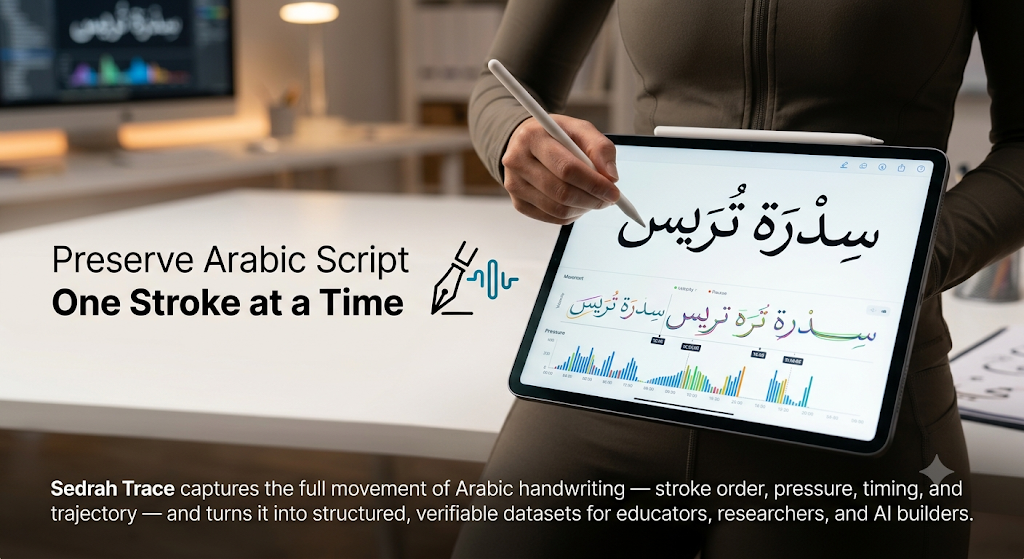
Conventional handwriting recognition begins with the finished image. Sedrah AI studies the process: where a stroke begins, how it moves, when the pen lifts, how letters connect, and how proportion develops through motion.
Product
An iOS app for children ages 4–10: 28 letters, all four forms, PencilKit tracing, illustrated words, and recorded audio.
The educational problem
A final image cannot show whether the learner began in the right place, followed a stable trajectory, or constructed a connection in a repeatable way.
Stroke order and pen lifts shape fluent letter construction.
Curvature, proportion, and baseline relationships develop through motion.
Contextual forms require attention to how one letter enters and leaves another.
Stroke-level intelligence
The intended system observes a time-ordered trajectory, aligns it with an educator-selected reference, identifies a meaningful deviation, and returns one clear cue.
Implemented. The existing research toolkit captures coordinate sequences and available pen signals from supported input surfaces.
Active research. Trajectory models are being investigated for order, direction, speed, curvature, and spatial relationships.
Active research. References must be tied to a script style, teaching method, learner level, and educator intent—not treated as a single universal form.
Planned. The learner receives a small, timely correction while the teacher retains control over the pedagogical standard.
Applications
Potential applications include guided practice, educator review, heritage-language programs, trajectory datasets, and handwriting research. Educational outcomes have not yet been established.
Practice tools can make invisible aspects of movement discussable while preserving the teacher’s role in instruction and interpretation.
Structured trajectory data can support questions in motor learning, HCI, script geometry, and responsible educational AI—with consent and governance built in.
Responsible use
Arabic writing includes regional, pedagogical, and calligraphic variation. Any evaluation must declare the selected reference tradition and surface uncertainty.