 Sedrah
Introduction
Emotion is rarely one-dimensional. In text, speech, and visuals, it appears as layered signals that change over time. Sentiment spirals help represent this progression as a narrative path instead of isolated scores.
This article summarizes our case studies and visual outputs to show how emotional trends can be interpreted for products, stories, and real-world media.
Amazon Product Review Sentiment
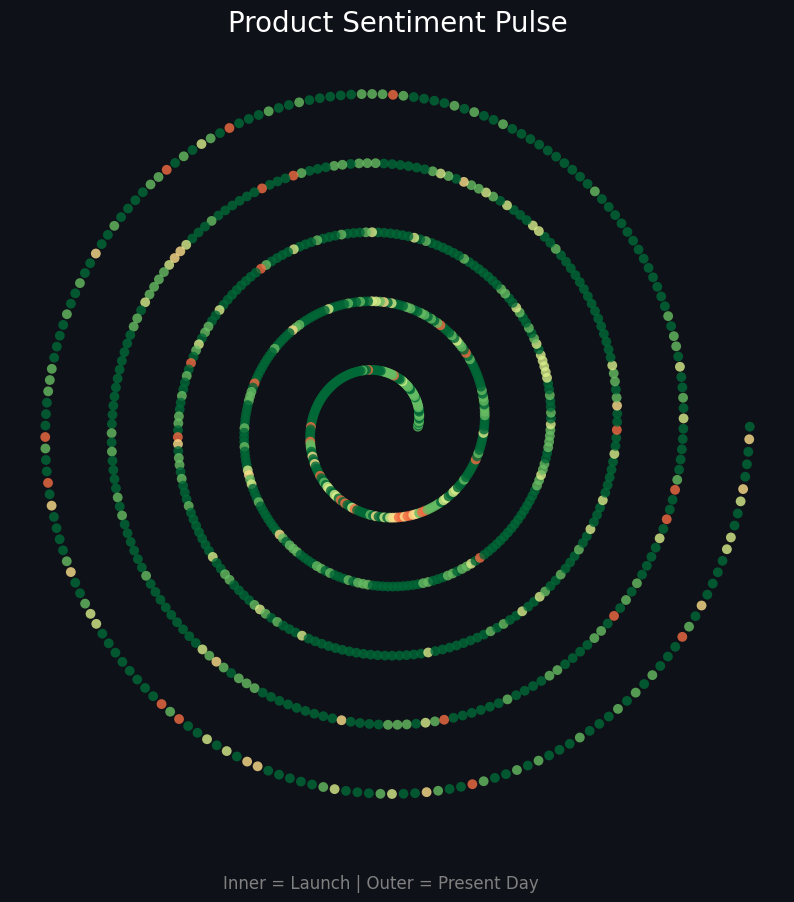
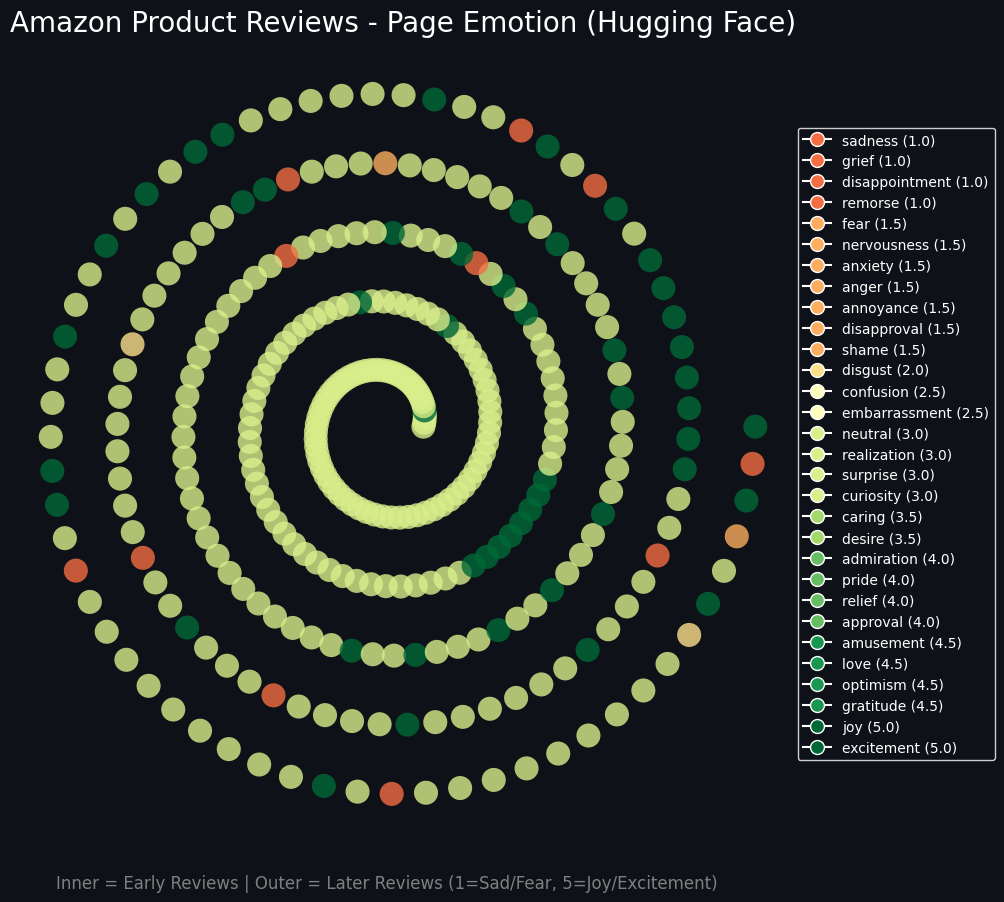
We started with a clean review dataset and mapped rating evolution over time. The resulting spiral gives a clear timeline from early customer reactions to current sentiment.
Alice's Adventures in Wonderland
Chapter-level and page-level sentiment shows a mostly neutral-to-mildly-positive emotional profile with gentle oscillations rather than extreme shifts.
This supports the narrative interpretation of the text as whimsical and exploratory, where confusion appears but sustained negativity is limited.
Frankenstein with Emotion Classifiers
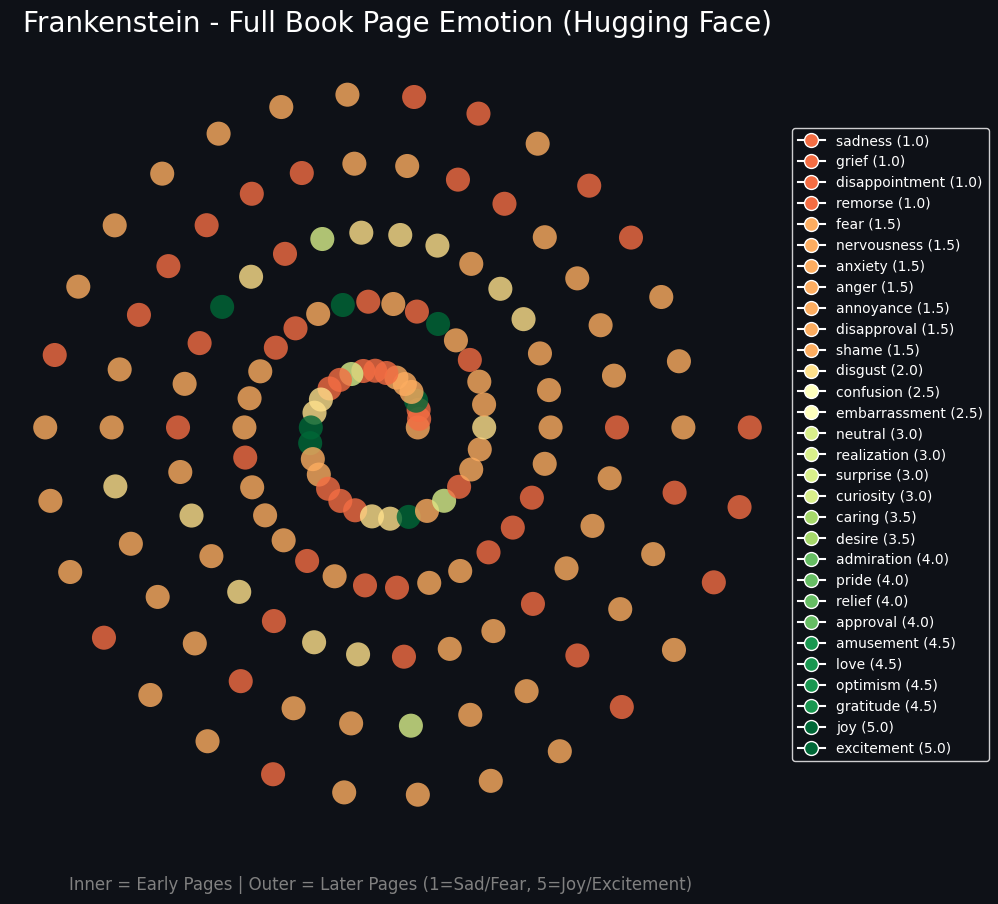
For Frankenstein, a fine-grained emotion model reveals a darker arc dominated by sadness and fear, with occasional short-lived positive moments.
Multimodal Emotion Analysis
We merged facial emotion detection and speech emotion recognition to produce a fused trajectory. This avoids over-trusting one signal and improves emotional reliability across time windows.

Why It Matters
Sentiment spirals and multimodal fusion turn large emotional datasets into interpretable narratives. For research, education, and enterprise intelligence, this offers a clear path from raw data to contextual insight.
At Sedrah.ai, we are extending this methodology for sacred and historical text intelligence where context, intent, and emotional transitions are essential.